10 Tips to Avoid Getting Scammed When Buying or Selling on OLX

OLX is the most popular online market place in Pakistan. Even casual users can easily buy and sell stuff online without any complications with OLX, given how simple the platform is. The platform targets ordinary citizens, and we believe it can be much better.

That being said, there seem to be certain issues that keep us from recommending a platform such as OLX and other similar ones.

Read More: OLX Is Becoming Useless and Here’s the Real Reason Behind its Fall

We recently reported on how spam ads were making the platform useless for the ordinary buyer and seller. If that wasn’t enough, there have been reports of several robber gangs operating by using ads on OLX. There has also been widespread assumption that people tend to lie about products or scam the buyer/seller through any other means.
All of these are dangerous scenarios that hurt the potential that OLX holds for online buyers and sellers.
All is not lost though, and to ensure that you utilize OLX to its fullest, we have made a list of tips which could help you keep yourself safe while using the platform to buy or sell items.

10 Tips for For Buyers On OLX

Buyers need to make sure that they are getting authentic products and that they don’t get robbed by some individual with malicious intentions. Many buyers here know most of these tips by now but as they say, common sense still needs to be more common before we can all heave a sigh of relief here.
Here’s what you should keep in mind as a buyer on OLX:
  • Don’t fall for unbelievably attractive offers. If it is too good to be true it usually is. Scammers make unbelievable offers to fool their counterparts. Compare more offers in case you have your doubts.
  • Ask for the condition of the item beforehand. Also finalize the price and the method of transaction/delivery. Preferably, meet the seller in person.
  • Pick a safe location. If buying a small item, meet in a public place with many people around you. Having a friend close by is a plus.
  • Inspect the item before purchasing or handing over money.
  • Ask the seller if they would be willing to give you a 24-hour period to make sure the item is fully functional.
  • Ask the seller to provide you with a copy of their CNIC (front only) with clear text regarding the checking warranty and preferably a signature. This can act as a receipt. At the very least you could have the same written on a blank piece of paper and validate it using the seller’s CNIC.
  • Take a picture of the item you purchased and the seller when you pay.
  • Collect the item and pay at the same time to avoid any trouble. Never trust someone you don’t know and transfer money in advance.
  • Do NOT give out your financial details.
  • If buying a car or a bike, confirm the documents via a third party to avoid being sold a stolen vehicle.

10 Tips for Sellers On OLX

Sellers face a host of issues too at OLX. They feel insecure because there’s no guarantee that their items won’t be stolen. There’s also the risk of getting robbed, or being scammed with fake notes.
As a seller on OLX, bear in mind these things:
  • Do not hide anything from the buyer. The responsibility of disclosing complete details rests with you.
  • If someone is paying you more than what you asked, leave it. More often than not, it’s the beginning of a scam.
  • Meet in a public place and have a friend close by.
  • Take full payment at the time of delivery.
  • Watch out for fake notes when paid. Don’t take money orders or cheques. Either get paid online (or via mobile wallets) immediately or get payment for your item in cash.
  • Ask for the buyer’s credentials if you receive a large bulk order. Also recommended is to sign a contract. This usually applies to business customers.
  • Make receipt in advance, even if it’s handwritten. Write your CNIC number, item name, check warranty duration, your signature. Ask the buyer to write their name and CNIC alongside.
  • Take a picture of the buyer, the receipt and the item, together, when you get paid.
  • Do not share your financial details other than the one necessary for payment.
  • If you are a regular seller, ask a courier service to deliver your items through Cash on Delivery (COD) while letting the buyer check the item after payment.

What If You Are Scammed By A Fraudulent Buyer or Seller?

If you have become the victim of a fraud, its time to notify the police immediately and use the proof (picture and receipt) against the culprit.
Also report any fraudulent sellers or buyers by filling OLX’s form here.

Advice for OLX and Other Marketplaces

Marketplaces need to conform with the local requirements. With increasing safety issues in bigger cities of the country, online marketplaces like OLX should at least introduce a proper and transparent rating system so that buyers and sellers can only select offers from reliable sellers.
While this may hurt newcomers, it is the way to go about so that people trust online shopping. Popular marketplaces around the world employ similar rating systems. This could also help high-rated sellers launch CoD (cash on delivery) services without the buyer having to worry about a product’s authenticity.
Up until now, OLX has not mediated any transactions, but perhaps a system could be launched to cater to the requirements of the market.

Govt Announces Smart Schools 4 Times in 8 Months, Fails to Actually Start It

It seems all government departments have either made a habit of re-announcing the same project again and again or they forget about projects completely after announcing them once.

Previously, it was the railways ministry which made the same online booking announcement several times over the course of one and a half years. The trend was picked up by other ministries and now this has popped up.
As we mentioned a few months ago, there is a certain pattern to these announcements and here’s how it happens every time:
  • After a project is announced, it is followed by complete media silence.
  • Once work on it is about to start, it’s announced again like it’s new project.
  • During the execution phase, there are multiple announcements depending on its duration.
  • The project is announced again as it nears completion.
  • When the execution phase completes, the project is inaugurated and announced again.
  • Few months after a project is inaugurated, it is announced yet again.
Every time the project is announced as if it were a new one.
So far the government has announced the Smart Schools project 4 times in 8 months. First in April, followed by announcements in July, August and December.
We have seen the above pattern several times during the past 4 years. It is amazing how the government makes fools of the public by letting them think it’s a new project once they forget about it.

Previous Announcement

Back in April, the government announced the establishment of 24 Smart Schools in Islamabad. Existing schools were to be upgraded with new facilities. We, like all others, appreciated the positive step.
The Central Development Working Party (CDWP) approved the project and tasked the Federal Directorate of Education, Islamabad (FDE) to implement the smart schools project.

December’s Announcement

8 months on, now the State Minister for Capital Administration and Development Division, Tariq Fazal Chaudhry, has tasked the FDE with the same project.
All details of the project are exactly the same. The same facilities will be introduced and the same procedures are to be followed.

About the Smart School Project

Smart Schools pilot project was estimated to cost around Rs. 498 million. The second phase’s estimated cost was Rs. 556 million. During the project the following provisions were to be made:
  • Installation of computers with UPS in the selected schools, with internet connectivity for computer labs.
  • Online learning access to e-learning facilities
  • Availability of high-quality online instructional material, catering to both languages (English & Urdu)
  • Initiating teacher training programs, introducing them to the current methodologies to improve their technical skills.
The pilot phase was to be completed by the end of this year. Unfortunately, that has not happened.
There were some issues with the program as well. Each desktop PC for the computer labs was estimated to cost Rs. 80,000 along with a UPS which would cost another Rs. 300,000. In short a price tag of Rs. 380,000 per computer.
Additionally, 80% of the budget was to be spent on hardware. Nearly nothing (just 1%) was allocated for the software, the essence of a smart school with blended learning.
600 tablets, each costing Rs. 30,000, were also to be available in computer labs and shared by 2 students. There was no mention of the make and model of the tablets and their potential benefit when computers were already available in computer labs.
These issues were pointed out by the Planning Commission and the education department but no answers were received.
The project was supposed to launch in 12 boys schools and 12 girls schools and it was meant only for students from class 3 onwards. About 5,500 students were expected to benefit from it.

The Real Question

Re-announcing the same thing again and again just for the sake of staying in the headlines is not right. The public loses interest and faith in the public institutions. It creates a negative mindset where the citizens start to think that these are mere announcements and won’t come to realisation.
The real issue, however, is that the government made the announcement 8 months ago. And this was only the pilot project limited to only 24 schools in one city. To top it off the project did not involve any large scale development work. Yet, there has been no progress on the project so far.
It’s the education sector again which has not received any proper attention from the government. Schools in the country are already sub-par. Even in the capital, most public sector schools lack basic facilities. The smart school project, even though a minor upgrade, was still a step in the right direction appreciated by the students and all stakeholders.
To ignore the pilot phase of a simple project for 8 months shows the ignorance of the authorities. Instead of self-promotion and marketing, government individuals should start taking this seriously and make sure that they at least start work on a project after it is announced.

A Request to the Government

We see several news go public again and again but for our readers and to maintain out quality to only offer actual news, we often ignore repeated announcements.
The government should always focus on working on projects instead of faking announcements by launching the same project again. The public is not going to fall for it and it hurts the actual projects’ credibility.
We request the government to please stop this and simply work on projects for the betterment of the public.

3 Reasons Why Winter in Pakistan is Warmer This Year

January 2017 has already started in Pakistan and the winter season is still rather mild in most areas. In fact, the weather seems more or less the same as in early October of the last year.

Many are wondering whether this is just an anomaly or will this become a permanent feature for Pakistan’s weather from now on. Farmers, rural areas, urban areas, towns, cities – you name it. Everyone is concerned since it seems like climate change has been affecting weather patterns on a global scale.
Today we will be looking at these questions:
  • Is climate change playing havoc with Pakistan’s weather?
  • How did it affect the weather in the country last year?
  • What are the reasons behind Pakistan’s change in weather this year?
The answer to the first question is yes, climate change has indeed affected Pakistan. And here’s how:

Winter in Pakistan During 2016-17

There’s been virtually no rain in most of Pakistan ever since the winter season started. December-January period usually comprises of regular rainfall with the temperatures dropping below 0 in most areas of Punjab, KPK, Balochistan and the northern areas including Azad Kashmir.
What’s more astonishing is that snowfall has also been scarce in the northern areas of Pakistan.
Temperatures in Islamabad haven’t dropped below 5 degrees Celsius. Similarly, the difference between maximum and minimum temperatures in Pakistan has been higher than usual. For example, in Lahore, the temperature difference has been about 13 degrees Celsius this winter compared to 7 degrees Celsius last year.
The day times are unusually warmer this year. Similar weather patterns have been reported in Karachi which hasn’t witnessed rains in months and temperatures have been so high that it still feels like late summer in the country’s biggest city, save for the occasional cold winter night or two here and there.
Why is this happening? We take a look at 3 reasons why:

Warm Weather Phenomena in Pakistan

Pakistan’s meteorological department has also confirmed that sudden weather changes are the cause of this climate phenomenon in Pakistan.

Warm air patterns within Pakistan are responsible for warmer winters

Anti-cyclonic circulations over Khairpur and Nawabshah region are spreading warm and dry winds, increasing the temperature. This has resulted in higher than usual temperatures in the surrounding regions as well.

El Niño Southern Oscillation Affect

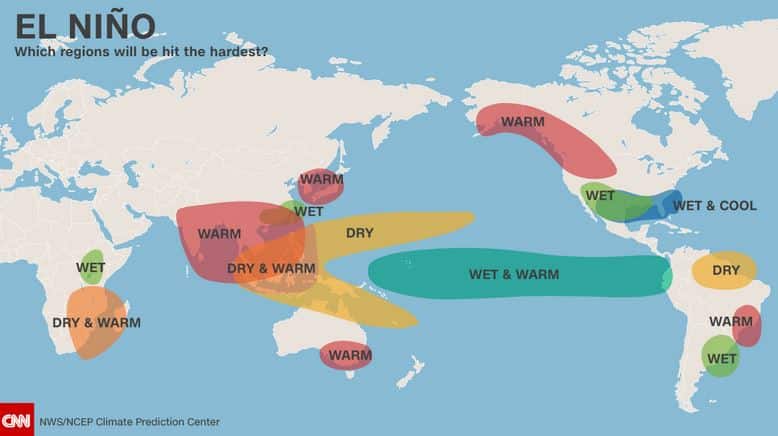
The secondary reason, is the El Niño Southern Oscillation (ENSO) affect. This ENSO, occurs every 3 to 10 years and causes severely warmer weather in the tropical central and eastern Pacific Ocean warms up. This leads to worldwide weather changes and severely affects the South Asian climate, causing droughts.

The stronger than ever El Niño affect causes warmer climates and less rain

The strong effects of the ENSO have previously had similar affects in Pakistan causing long spells of no rain and warmer climates. El-Nino years are considered to be the reason for higher temperatures in the region during winter.
With no rain and little moisture in the air, it’s hard for people to wear warm clothing during the current winter season.

Change in Western Weather Patterns

Another usual occurrence for Pakistan are the Western Disturbances. Winds and rains result due to these western weather patterns. Coming from the Mediterranean Sea, these disturbances bring moderate rainfall to the southern areas of Pakistan and heavy rainfall/snowfall in the northern part of the country.

Western disturbances are less intense in 2016 winter

This winter, these Western Disturbances are less intense as moisture in the air gets drained before it reaches Pakistan. This has resulted in less rain and no chilly wind flow, ultimately preventing the temperature from falling to usual levels in both, the mountainous and plain areas of the country.

Final Words

This is the warmest year on earth since 1880, with almost every single month breaking records set in the past years. It might rain or snowfall a little in the northern areas of Pakistan, however these scarce rains are not expected to bring the temperatures down by a lot. Additionally, normal rainfall or temperatures are not forecast for the near future.
With the warmer temperatures in mind, an early spring season could be expected in 2017. This could very well mean a rather short-lived winter season that never was. With the effects of climate change becoming ever more severe, one has to wonder if the winter season is every going to be the same.

ZEOZ: A Voice Driven Market to Connect Buyers & Sellers

Digital auction and e-commerce markets in Pakistan and across the globe have seen strong growth in the last decade or so and whilst many companies are still hoping to tap this lucrative market, ZEOZ has entered as a dark horse and unique player.

ZEOZ looked at the current scene in Pakistan regarding online shopping and developed what it and many others believe is a game changing tool for people who value trade.
Its solution? A voice driven application for buyers and sellers to connect and exchange information in local dialect using easy voice messaging services to save time in finding local buyers and sellers.

For buyers, ZEOZ lets you choose what you need without having to search the web, phone directory or any contact list for that matter. Record a voice message and have results instantly appear as local sellers hear your request and reply using the app.

For sellers, ZEOZ is a unique opportunity to communicate directly with local business to advertise goods and services sold almost the moment a search is performed by the buyer.
Since concept and design, the company developing the smartphone application has moved through several phases of research, design and development before bringing it to market for us to see.
Over the course of its development, the service provided by the app has been compared by early adopters in the US, UK and Gulf to existing ‘search methodologies’, virtual assistant services like ‘Google Now’, ‘Siri’, ‘Cortana’ and even the likes of ‘Uber’ in its advent but what the company has decided is to anchor in the online auction and e-commerce space.
For Pakistan, this is the first time voice services are being provided in the e-commerce sector; inquiring about the available services near you can be done through sending a simple voice message.
It is important to note that the company is reaching out to all Pakistani businessmen at home and abroad to sign up as a seller of goods and services in their area of expertise no matter what domain.
Companies, Commerce Chambers, Economic Professors and Govt. officials wanting to learn more about the business plan, disruption and application of digital currency are welcome to write to hellopk@zeoztheapp.com for further information.
The application has also passed multiple phases of testing and is ready to stress test with a larger user base across the country.
When compared to other services, ZEOZ provides a much effective approach which is beneficial for both buyers and sellers; the increase in communication increases the chance of more sales thus resulting in a number of customers dealt.

How Does It Work?

The working of the ZEOZ service is simple; it acts as a third party and connects the service providers with the users seeking those particular services.

Buyers:

Suppose you are out of town and looking to get a haircut. What do you do? Here are the following steps:
  • Get the app ZEOZ available at Apple and Google Play.
  • Create an account.
  • Choose area where you require service and see services in a 20km area.
  • Select from trending services or your favorites list to pick your hairdresser.
  • Send a voice message stating what you seek e.g. availability and costs.
  • View a list of listed hairdressers.
  • Have 1 or many reply.
  • Negotiate a time and visit the shop to get your haircut in your allocated time slot.
Time sensitive services such as requiring blood on urgent basis is what sets ZEOZ apart. Instead of Googling a blood banks contact information and then waiting for them to pick up, you can broadcast a message saying how much blood you require and all the blood banks near you will respond. You can then select one bank and visit to pick up the blood units of your requirement, as per the agreed terms through the ZEOZ application with the blood bank.
Similar steps need to be followed if you are looking for something more pleasant such as a nice cup of coffee. The coffee shops in your vicinity will respond you with their offers from which you can select.
Other things you will find:
  1. A map with all local business listed in a radius of 20 km.
  2. Local trends, favorite sellers and new options available to pre-order.
  3. Facility to ask local sellers what’s new and make reservations from wherever you are.
  4. Instant results of targeted local sellers with business name, website, description, rating, distance and online status.
  5. User profiles with options to hear reviews.
  6. Rate services and add reviews for others to hear.
  7.  Voice messaging services.
  8.  Free calls to local business online (where conditions allow)

Sellers:

Often small businesses are overshadowed by larger companies with greater advertising and marketing budgets. ZEOZ provides a fair opportunity to all the people looking to promote their ventures. From a house keeper to home delivery service, everyone can enlist their services.
While there are no charges for the buyers, sellers of goods and service providers will be required to pay a fee (subject to change) to connect with buyers to promote and offer their services.
For services not found or listed, you will need to contact local ZEOZ management via the app.
For the seller’s section, the company writes:
  1. Option to sign us as a seller to engage with local trade immediately.
  2. A business to business local advertising and marketing platform.
  3. Free calling with prospective buyers.
  4. Seller account options to target select markets with services and products for sale.
  5. Favorites list of people you work with direct or rely upon for services from anywhere in the world. For example, car traders, estate agents, travel operators and freelancers.
  6. Bonus credit for connecting with local business.
  7. Revision to user interface based on seller feedback.
To end, ZEOZ brings a unique proposition to the economy and stands to challenge new and existing auction and e-commerce ecosystems. The human element is simply a bonus to search technology.
Disclaimer: The next phase of application testing requires a much larger user base and if any faults are found, you are invited to leave comments with Pro Pakistani for Team Z or direct back to the feedback section of the ZEOZ application.

Bloggers Arrested in Pakistan for Posting Fake Images Online

Few fellow bloggers are reportedly missing for more than 12 hours now as they are not responding on their mobile numbers after appearing before FIA Cyber Crime Wing Islamabad yesterday morning, sources have confirmed ProPakistani.

At least three bloggers had been asked by FIA Cyber Crime Wing Islamabad to present themselves before investigation officer on (Dec 31st, 2016) for posting images of Prime Minister Nawaz Sharif with a PML(N) leader while wrongly attributing him as Justice Saqib Nisar.
Bloggers, while they had removed the images, made themselves available at FIA office Islamabad but only to get arrested.
Families of these bloggers, when contacted, were clueless and had no idea on whereabouts of their kids.
These part time bloggers, hailing from Multan, had posted images in question online and FIA was able to track them down through WHOIS information available on their website.
Not to mention, these three bloggers were among few thousands other online users who had shared the images in question on Whatsapp, Facebook and through other social media channels.
Through sources we know that these bloggers are now detained by the FIA, however, nothing has been said officially on the matter as of yet.
It must be mentioned here that Ch. Nisar, Interior Minister, had ordered the FIA to investigate the culprits behind spreading fake image of Mr. Sharif with Chief Justice.
As it is clear to everyone, instead of catching the original posters, FIA will nab easy targets only.
While we aren’t certain about the section of cyber crime bill that’s being investigated, but from the looks it appear that bloggers might be charged with “Cyber Terrorism”.
Section 7 of Cyber Crime Law deals with Cyber Terrorism and it says:
= the use of threat is designed to coerce, intimidate, overawe or create a sense of fear, panic or insecurity in the government or the public or a section of the public or community or sect or in society
Since we don’t have information on what section are they going to get charged with, its early to comment about any consequence.
But just to give you an idea, Under this section, if proven guilty, these bloggers could face up to 14 years in prison or/and up to Rs. 50 million in fine.
It must be mentioned that there are more bloggers, and a hosting provider who were also sent these notices but are out of Pakistan as of now.
While we had warned you before, this is what Cyber Crime law was all about. Post a fake image on Facebook — which is obviously wrong — and get behind the bards immediately, with no warrants, investigation or trial at all.
This is a developing story and will be updated as we get more information on it.

National IT Policy to be Submitted for Final Approvals in One Month

 Ministry of Information Technology and Telecommunication has completed consultation on the draft of National IT Policy 2016, envisaging software and telecom enabled service exports at $6 billion by 2020.

Earlier this month, the ministry made the draft of National IT Policy 2016 public for views, comments and feedback.
According to the officials concerned, consultation process is almost complete now and the draft policy will be given final shape soon.
It is expected that the draft policy will be submitted to the Economic Coordination Committee (ECC) for approval next month, an official added.

Read More: Ministry Finalizes IT Policy Draft, Envisions $6 Billion in IT Exports by 2020

However, stakeholders have termed the exports target of $6 billion by 2020 as unrealistic while keeping the ground realities in view.
Syed Ahmad CEO of DPL Software Company said government claims that IT exports are about $2.5 billion, however, State Bank of Pakistan’s (SBP) data reflects only $500 million. There is no study to measure the exact exports figures or to find out why there is discrepancy in govt and SBP figures, he added.
Syed Ahmad further said that exports of formal IT industry range between $500-600 million and non-formal industry i.e. freelance is around one billion dollars. However, it is not easy to regulate the freelancers to report the actual figures. IT exporters said that government needs to give incentives to the sector, especially to the freelancers, to increase the exports.
About the IT Policy 2016
Some of the key features of the National IT Policy draft are sectoral digitization, big data, data analytics, entrepreneurship, Internet of Things (IoT), e-commerce, e-agriculture, software export.
According to the draft policy, there has been higher growth in recent years in the Pakistani IT industry as a whole with IT firms earning nearly $560 million, mainly in software development and service outsourcing. However, it has been estimated that around 75 percent of earnings are held overseas to finance the cost of foreign offices and international marketing making the real figure in excess of $2.2 billion. IT exports have witnessed a 41 percent increase during last one year.
The draft policy states that Pakistan has more than 2000 IT companies and calls centers and the number is increasing every year. Pakistan has more than 300,000 English-speaking IT professionals with expertise in latest IT products and technologies. More than 20,000 IT graduates and engineers are being produced every year.

Read More: National IT Policy 2016 To Focus On Killing Piracy & Increasing Internet Security

Pakistan has 14 Software Technology Parks at present with an area of one million square feet with more being planned for the future. Freelancing revenue is another $90-100 million per year, domestic revenue is roughly around Rs 30 billion or $300 million and the market of cellular mobile companies is huge with total imports of Rs 73.224 billion for the fiscal year 2014-15. All these of reflect a promising IT landscape in Pakistan.
The policy is targeting to enhance exports of software and IT/IT enabled services to create jobs and contribute towards the government’s efforts to increase overall exports and IT remittances.
The policy mainly concentrates on emerging areas of mobile applications, responsive web applications, and animation. It is also focused on moving up the global IT value chain while it is also exploring new areas where low end business process outsourcing jobs can be created.
The policy aims to attract multinational global companies to utilize Pakistani manpower for back-end services by providing appropriate incentives in a transparent manner, utilize the Pakistani diaspora in the US and European markets to plug young entrepreneurs into the global IT value chain. The policy is aimed at providing enabling environment for companies to set up venture capital and other financing mechanisms to start up companies.
The ministry spokesperson said that given the growing trends of information technology, it has become imperative to reformulate the National IT Policy to take into account the transformative fundamentals of technology and its ecosystem centered on digitization.
I generally start with a very simple question with my interview candidates. I ask the for writing a program for giving the integer average of 2 integers using only integer type variables. Assume that input will always be with in integer limits.

The definition of integer average is the highest smaller integer if average is floating point number. Also the condition if that they can not use any typecasting or any datatype other than int.

Example:
a = 4, b = 5, avg = 4
a = 4, b = 6, avg = 5
a = -4, b = -6, avg = -5
a = 4, b = -5, avg = -1
a = -4, b = -5, avg = -5

95% of candidates smell some issues in this problem and when I say nothing is there they don't even ask any clarification and come up with something like this: 
1int get_average(int a, int b)
2{
3 return (a+b)/2;
4}

Then I ask them to have a look if this is correct on definition and then they see that it is. But there test failed on very first floating point negative average. Then most of them do a quick fix and come up with something below:
int get_average(int a, int b)
{
 int sum = (a+b);
 if (sum < 0)
  return sum/2 - 1;
 return sum/2;
}

The above solution is obviously wrong if sum if a even negative number. I am disheartened to see why do these candidates just solve a test case and show the solution. They don't even care to run this with some examples.

On pointing this, most of them correct the code. Others face the rejection at this stage.


int get_average(int a, int b)
{
 int sum = (a+b);
 if (sum < 0 && sum%2 != 0)
  return sum/2 - 1;
 return sum/2;
}

Now I ask them to make it production worthy and taking care of boundary conditions. Many of them are not able to do so but some of them go through it for my second question.

Though I expect this problem to be concluded within 30 minutes depending of their experience but candidates do a lot of silly mistakes and stretch.

Lets see if you can code this correctly.

#include <iostream>
using namespace std;


int get_average (int a, int b)
{
 int a_half = a/2;
 int b_half = b/2;
 bool a_even = a%2==0? true:false;
 bool b_even = b%2==0? true:false;
 if (a>=0 && b>=0)
 {
  if (!a_even &&  !b_even)
   return a_half + b_half + 1;
  return a_half + b_half;
 }
 else if (a<0 && b<0)
 {
  if (a_even &&  b_even)
   return a_half + b_half;
  return a_half + b_half - 1;
 }
 else
 {
  int sum = a+b;
  if (sum < 0 && sum%2 != 0)
    return sum/2 - 1;
   return sum/2;
 }

}

int main()
{
 int n, a, b;
 cout << "number of test cases: ";
 cin >> n;
 for (int i=0; i<n; i++)
 {
  cout << endl << "Enter a and b: ";
  cin >> a >>b;
  cout << "average = " << get_average(a,b) << endl;
 }
}